
For most organisations, the future of adult learning is not constrained by access to content.
There is no shortage of leadership frameworks, capability models, or well-designed programs. Most experienced leaders can articulate what good leadership looks like. Many can reference familiar theories, from situational leadership to psychological safety, with ease.
And yet, under pressure, behaviour often looks unchanged.
This tension is shaping the future of adult learning. Not a question of what leaders know, but of what they can access and apply in the moments when it actually matters.
The problem adult learning hasn’t solved yet
Traditional adult learning has largely been built around a rational assumption: if adults understand the concepts, reflect on them, and practise them in safe environments, behaviour will follow.
That assumption is increasingly at odds with what behavioural science tells us.
Research on decision-making under cognitive and emotional load consistently shows that under pressure, people default to habit rather than intention. Judgement narrows. Emotional regulation becomes harder to access. Even well-established skills can become temporarily unavailable.
📎 Read more on decision-making under pressure HERE
The breakdown rarely happens in the classroom.
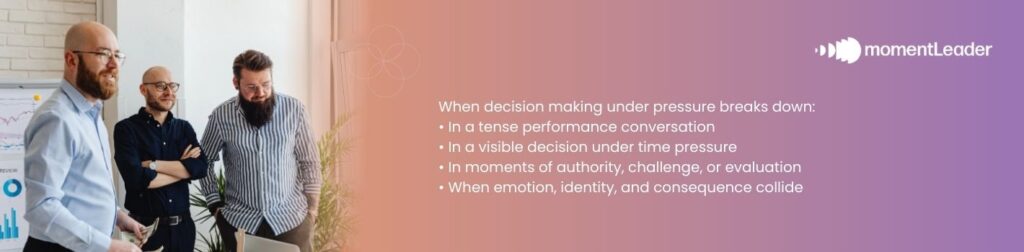
In these moments, leaders don’t reach for frameworks. They revert to patterns.
This is not a motivation problem. It is a state-based capability issue — something most adult learning systems were never designed to address.
From knowledge acquisition to behaviour under pressure
One of the most important shifts underway in adult learning is a move away from knowledge accumulation toward supporting behaviour in context.
This aligns with long-standing insights from learning transfer research.
Decades of leadership development research point to the same conclusion: insight alone does not reliably predict behaviour change. What matters is whether leaders can access judgement at the point of application.
📎 Read more on leadership behaviour HERE
The core question is shifting.
Instead of: “What should leaders learn?”
The more useful question becomes: “What support helps leaders choose deliberately when pressure is highest?”
This reframes adult learning around:
- Behaviour, not just capability models
- Moments, not programs
- Choice, not compliance
Where leadership development reaches its edge
Most learning strategies are designed for reflection after the fact.
360 feedback, coaching debriefs, and structured reflection play a critical role in helping leaders make sense of their behaviour and intent over time. They create language, insight, and shared expectations.
What they are less able to do, by design, is support leaders in the precise moment when pressure is highest and judgement is most constrained.
As a result, even in organisations with strong leadership programs and high-quality development experiences, there can be variability in how consistently leadership shows up in day-to-day moments — particularly when stakes are high.
📎 Read more on leadership development impact gaps HERE

Learning that meets leaders where pressure lives
What’s emerging instead is a different design philosophy — one that reflects both behavioural science and modern work realities.
Rather than adding more content, adult learning is moving closer to the moment itself:
• Short prompts rather than long modules
• Reflection before or during action, not only after
• Language that helps leaders slow the moment, not accelerate it
• Support embedded into real work, not separated from it
What’s emerging instead is a focus on smaller, well-timed interventions that support choice in real work, rather than complex interventions delivered far from the moment itself.
📎 Read more on BJ Fogg’s behaviour model HERE
Seen this way, learning becomes a companion to leadership, not an interruption.
Where AI begins to matter — carefully
AI is increasingly entering the adult learning conversation, often framed as a solution in itself.
That framing is risky.
There is growing recognition that AI is most valuable when it supports human judgement rather than attempting to replace it — particularly in complex, high-stakes decisions.
📎 Read more on AI and human judgement HERE
For adult learning, this positions AI not as a coach or answer engine, but as infrastructure:
• Supporting awareness in moments of pressure
• Helping leaders notice patterns in their reactions
• Prompting reflection close to the moment of choice
• Reinforcing learning where transfer typically breaks down
The future of adult learning will depend on whether AI is used to strengthen attention and composure, or simply to accelerate advice.
Leaders do not need faster answers. They need steadier access to judgement when it’s hardest to reach.
A different definition of progress
For senior L&D and talent leaders, this evolution requires a shift in how effectiveness is understood.
Progress is not best measured by:
• Completion rates
• Framework adoption
• Program satisfaction scores
It shows up instead as:
• Greater consistency in leadership behaviour
• Fewer reactive moments under pressure
• Clearer cultural signals in visible decisions
• Stronger transfer from learning into daily work
These outcomes align closely with what leadership research bodies like the Center for Creative Leadership have long emphasised: leadership effectiveness is experienced in moments, not assessed in isolation.
The future is quieter than we expect
The future of adult learning is unlikely to arrive as a single new framework or platform.
It will emerge quietly, as organisations redesign learning systems to support leaders in the moments that are interpersonal, visible, and consequential.
It will be shaped less by what leaders know, and more by whether they recognise themselves when pressure is on.
The organisations that move first will be those willing to design adult learning not just for understanding, but for behaviour under load.
Over time, the future of adult learning will be shaped by what leaders do in live moments, and how well learning systems support those choices under pressure.
📎 Read more on coaching industry trends HERE
If you’re exploring how to support better judgement in the moments that matter most, momentLeader can be a thinking partner. Learn more HERE
AUTHOR: Cara Leverett
Cara works across strategy, social media and consulting, supporting organisations to build visibility and meaningful engagement in the coaching, leadership development and adult learning space. She is particularly interested in how coaching-led learning and HR technology can be combined to create meaningful behaviour change and scalable impact for leaders and teams. Her work sits at the intersection of strategy, creativity and innovation, with a focus on translating complex ideas into clear, engaging narratives.
Drawing on a foundation in communications and creative problem-solving, Cara brings an innovative and considered perspective to her work across HR technology and digital learning platforms. She is curious about how organisations use digital tools, insight-led content and coaching experiences to support growth, performance and culture. Cara enjoys shaping ideas that resonate with senior HR, OD, L&D and talent leaders, and turning strategic thinking into content that connects and drives action.