Most organisations asking this question already have a learning strategy.
They have leadership programs, capability frameworks, digital platforms, workshops, coaching, feedback cycles, and well-designed content. Participation rates are often strong. Evaluation scores are acceptable. Leaders can usually articulate the behaviours the organisation values.
And yet, when pressure rises, behaviour often reverts.
Decisions narrow. Conversations shorten. Old habits resurface. The organisation “knows” more than it can reliably enact.
This is the tension behind the question. The challenge is rarely commitment to learning. It’s whether learning is structurally accessible when work becomes demanding.
Continuous learning is not an attitude problem
Culture conversations often drift quickly toward mindset: curiosity, growth orientation, psychological safety, personal ownership.
These qualities matter. But they don’t explain why capable, motivated leaders still struggle to apply what they know in live, consequential moments.
Under load, human systems behave predictably. Attention compresses. Emotional regulation costs more. Judgement relies on default patterns rather than deliberate choice. This is not a failure of values or intent. It’s a function of how the system interacts with pressure.
A culture of continuous learning, viewed through a systems lens, is less about encouraging people to learn more — and more about reducing the distance between knowing and choosing in the flow of work.
Read more on coach led learning HERE
Learning cultures are shaped by moments, not messages
Culture is formed where behaviour is visible, repeated, and evaluated. That means learning culture is shaped less by what the organisation says about development, and more by what happens in everyday leadership moments:
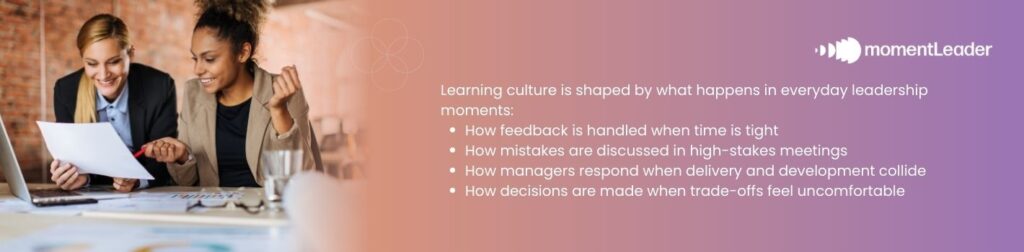
In these moments, leaders are not deciding whether they value learning. They are deciding — often unconsciously — whether reflection, curiosity, and restraint feel accessible or costly.
Over time, these micro-choices become signals. And signals compound.
Why traditional learning investments hit a ceiling
Workshops, programs, coaching, 360 feedback, and reflective debriefs are essential foundations. They build shared language, insight, and intent. They help leaders recognise what good looks like.
What they cannot fully control is the moment of application.
Most development systems operate before or after action:
Preparation
Reflection
Reinforcement
But culture is shaped during action — when leaders are under social, emotional, and performance pressure.
This is where many learning cultures stall. Not because the learning is poor, but because the system offers limited support for accessing judgement in the moment itself.

Continuous learning as a system capability
From a systems thinking perspective, continuous learning is not a program. It’s a property of the environment leaders operate in.
Healthy learning systems tend to share a few characteristics:
1. Learning is embedded in work, not added to it
Reflection is brief, timely, and linked to real decisions. Leaders are supported to notice patterns while they are still unfolding, not weeks later.
2. The system normalises pause under pressure
Not long pauses. Micro-pauses. Small moments where leaders can regain perspective before reacting. Over time, this changes the behavioural rhythm of the organisation.
3. Feedback is frequent and low-drama
Feedback isn’t reserved for formal cycles. It’s part of how work progresses. This reduces threat and increases learning velocity.
4. Capability language is shared, but behaviour is contextual
Leaders don’t need more models. They need help translating familiar concepts into the specific moments they are facing right now.
5. The organisation reinforces judgement, not just outcomes
When leaders are recognised for how they decide — not only what they deliver — learning becomes safer and more visible.
None of these replace formal development. They make it usable.
The role of in-the-moment leadership capability
One of the least addressed gaps in learning systems is state.
Leaders don’t fail to apply learning because they forget it. They struggle because pressure changes how they think, feel, and perceive options.
Supporting continuous learning therefore requires supporting leaders’ ability to:
Notice when they are triggered
Regulate enough to widen judgement
Make deliberate behavioural choices in live moments
This is not therapy. It’s not coaching in the traditional sense. It’s operational capability — the ability to access sound judgement under load.
When organisations strengthen this layer, something shifts. Learning stops being episodic and starts to feel continuous, because leaders are practising choice repeatedly, in real time.
Organisational Culture follows what the system makes possible
The most useful question for leaders designing learning culture is not:
“How do we get people to learn more?”
It is:
“What does our system make easy or hard to do under pressure?”
If reflection only exists after the fact, learning will feel optional.
If judgement is only discussed in calm environments, behaviour will fracture under stress.
If leaders are rewarded solely for speed and certainty, curiosity will quietly disappear.
But if the system helps leaders slow the moment just enough to choose well, learning becomes part of how work actually gets done.
A reframing worth holding
Creating an organisational culture of continuous learning is not about more content, stronger messaging, or higher expectations.
It is about designing conditions where leaders can repeatedly access what they already know — in the moments that shape trust, performance, and culture.
Small choices, made visible, repeated over time, change systems.
That is where learning becomes continuous — not as an initiative, but as a lived organisational capability.
If you’re exploring how to support better judgement in the moments that shape behviour day to day, momentLeader can be your thinking partner. Learn more HERE

AUTHOR: Cara Leverett
Cara works across strategy, social media and consulting, supporting organisations to build visibility and meaningful engagement in the coaching, leadership development and adult learning space .She is particularly interested in how coaching-led learning and HR technology can be combined to create meaningful behaviour change and scalable impact for leaders and teams. Her work sits at the intersection of strategy, creativity and innovation, with a focus on translating complex ideas into clear, engaging narratives.
Drawing on a foundation in communications and creative problem-solving, Cara brings an innovative and considered perspective to her work across HR technology and digital learning platforms. She is curious about how organisations use digital tools, insight-led content and coaching experiences to support growth, performance and culture. Cara enjoys shaping ideas that resonate with senior HR, OD, L&D and talent leaders, and turning strategic thinking into content that connects and drives action.