
Leadership performance is often evaluated by the quality of visible decisions: who gets promoted, how conflict is handled, which priorities are funded, what gets escalated and what gets contained.
Yet inside organisations, the cumulative cognitive toll behind those decisions receives far less attention.
Senior leaders rarely make a single high-stakes call in isolation. They move through dozens of micro-judgements before midday — resource trade-offs, tone adjustments in difficult conversations, risk calibrations, approvals, strategic reframes. Each one draws from the same finite neural systems responsible for executive control, impulse regulation and complex reasoning.
By late afternoon, the leader who began the day composed, deliberate and measured may still be experienced and capable — but the brain that supports that judgement is operating under load.
This is decision fatigue.
And for organisations investing heavily in leadership development and performance frameworks, it represents a structural blind spot: capability is built in programs, but judgement is tested in real time, under cumulative strain.
What Is Decision Fatigue — From a Brain Perspective?
Decision fatigue refers to the measurable decline in decision quality after extended periods of cognitive demand.
The prefrontal cortex — responsible for executive function, self-regulation and future-oriented thinking — consumes significant metabolic energy. When leaders continuously evaluate options, suppress impulses, weigh trade-offs and regulate emotion, neural resources deplete.
Under depletion:
- Judgement narrows
- Risk tolerance shifts (either over-cautious or impulsive)
- Emotional regulation becomes less accessible
- Leaders default to habit rather than intention
This is not a motivation issue. It is neurobiology.
Research in behavioural decision science has consistently shown that as cognitive load increases, individuals rely more heavily on heuristics and familiar patterns. Even experienced professionals revert to automatic responses when executive control is strained.
Dr Andrew Huberman’s work on neurobiology explains how sustained cognitive effort and stress hormones alter prefrontal functioning and bias behaviour toward immediate relief rather than long-term optimisation.
📎 Listen on stress and executive function
How Cumulative Decision Load Erodes Leadership Performance
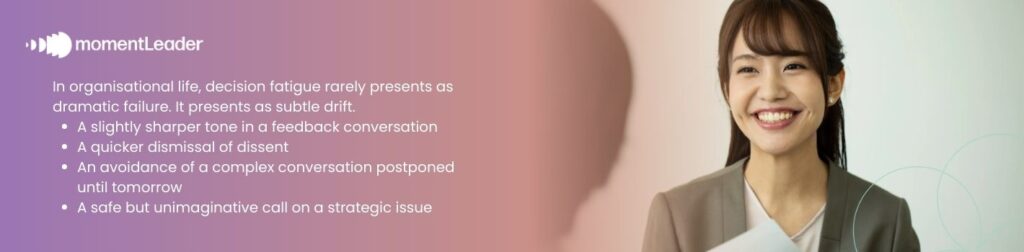
Over time, these micro-adjustments accumulate.
Behavioural science shows that when cognitive resources are taxed, individuals prioritise short-term resolution over long-term alignment. For leaders, this means:
- Reduced curiosity
- Lower tolerance for ambiguity
- Greater reliance on familiar solutions
- Increased susceptibility to bias
Research examining judicial rulings famously demonstrated that favourable decisions declined as judges progressed through sessions, improving only after breaks. While the context differs, the pattern is instructive: cognitive depletion alters evaluative judgement.
📎 Read more on decision patterns and fatigue:
For leadership performance, the implication is structural. High judgement quality cannot be assumed to remain stable across a 10-hour executive day.
Why Senior Leaders Are Especially Vulnerable
Senior leaders carry asymmetric decision weight.
They face:
- Higher consequence decisions
- Greater ambiguity
- More visible evaluation
- Compressed timeframes
- Competing stakeholder expectations
Their days are rarely designed to protect cognitive bandwidth.
Unlike operational roles, executive calendars often compress complex human decisions into narrow windows between strategy discussions, financial reviews and external engagements. By the time a critical people decision arrives — a termination, a succession call, a conflict escalation — cognitive reserves may already be compromised.
This matters because people decisions are not purely analytical. They require:
- Emotional regulation
- Perspective-taking
- Fairness calibration
- Long-term cultural thinking
These functions depend heavily on the very neural systems most vulnerable to depletion.
Dr David Eagleman’s work in neuroscience highlights how much of human decision-making is influenced by unconscious processes, particularly when cognitive resources are limited. When leaders are fatigued, unconscious bias and prior patterning play a larger role in shaping outcomes.
Late-Day Leadership Decisions: A Cultural Risk Factor
Many of the most consequential leadership moments occur late in the day:
- Performance conversations
- Promotion discussions
- Succession reviews
- Hiring decisions
- Escalation calls
If decision fatigue is present, leaders may unconsciously:
- Choose the path of least resistance
- Delay difficult calls
- Overcorrect to appear decisive
- Favour familiar profiles over diverse talent
- Prioritise speed over depth
At scale, this creates cultural signal distortion.
An organisation may articulate values around fairness, inclusion and long-term performance — yet judgement under fatigue subtly shapes outcomes that contradict stated intent.
The issue is not a lack of leadership capability. Most senior leaders understand sound decision principles. The gap appears when cognitive load interferes with access to that capability in live moments.

What This Means for Leadership Development Systems
Leadership programs build knowledge.
Coaching builds insight.
360 feedback increases awareness.
All are essential foundations.
However, decision fatigue operates at the state level. It influences whether leaders can access what they already know in the moment of choice.
For organisations accountable for leadership performance and ROI on development investment, this raises critical design questions:
- How are leaders supported in managing cumulative cognitive load?
- Are critical people decisions structurally protected from depletion?
- Do leaders have mechanisms to pause, recalibrate and re-engage deliberate judgement?
- Is leadership capability reinforced in the flow of work, not only in reflection after the fact?
Neuroscience makes one principle clear: behaviour under load is often the truest indicator of leadership quality.
If development systems do not account for cognitive state, performance variability is predictable.
Leadership Judgement Is a Capacity Issue, Not Just a Capability Issue
Capability refers to skills and knowledge.
Capacity refers to whether the leader can access them under pressure.
Decision fatigue directly affects capacity.
When leaders cannot reliably access calm, deliberate thinking in high-consequence moments, performance drift occurs — even among highly trained professionals.
For organisations serious about leadership consistency, the question is not whether leaders understand good judgement. It is whether the system enables them to enact it repeatedly, across an entire day of decisions.
Small structural choices — protecting cognitive recovery, embedding deliberate pauses, reinforcing reflection in real time — compound into stronger leadership performance over time.
Because leadership is shaped in moments.
And moments accumulate.
FAQ: Decision Fatigue and Leadership Performance
What is decision fatigue in leadership?
Decision fatigue is the decline in judgement quality after sustained cognitive effort. In leadership roles, it affects strategic thinking, emotional regulation and bias management.
Does decision fatigue affect senior leaders differently?
Yes. Senior leaders face higher consequence decisions, greater ambiguity and compressed timeframes. Their cognitive load is typically sustained and cumulative.
Can experience prevent decision fatigue?
Experience supports pattern recognition, but it does not eliminate neural resource depletion. Even highly experienced leaders revert to habit under load.
Why does decision fatigue matter for performance reviews and promotions?
Critical people decisions require fairness, perspective and long-term thinking. Fatigue increases the likelihood of bias, avoidance or over-simplification.
What improves leadership judgement under load?
Structures that protect cognitive bandwidth, encourage deliberate pausing and reinforce state awareness improve consistency of leadership performance.
AUTHOR: Cara Leverett
Cara works across strategy, social media and consulting, supporting organisations to build visibility and meaningful engagement in the coaching, leadership development and adult learning space .She is particularly interested in how coaching-led learning and HR technology can be combined to create meaningful behaviour change and scalable impact for leaders and teams. Her work sits at the intersection of strategy, creativity and innovation, with a focus on translating complex ideas into clear, engaging narratives.
Drawing on a foundation in communications and creative problem-solving, Cara brings an innovative and considered perspective to her work across HR technology and digital learning platforms. She is curious about how organisations use digital tools, insight-led content and coaching experiences to support growth, performance and culture. Cara enjoys shaping ideas that resonate with senior HR, OD, L&D and talent leaders, and turning strategic thinking into content that connects and drives action.